
The Second Judicial District
Minnesota's unified trial court is split into 10 judicial districts. The Second Judicial District covers Ramsey County. The Judicial Branch overview lists 296 district court judges statewide. Ramsey County District Court judges hear cases in all categories under one bench. The chief judge presides administratively, supported by Court Administrator Heather Kendall. The official court page sits at mncourts.gov/find-courts/ramsey.
The Sheriff's Office page is also tied closely to the District Court because criminal calendars, warrants, and jail bookings flow between the court and the Sheriff. Sheriff Bob Fletcher's office at 425 Grove Street shares the Law Enforcement Center building with one of the criminal-calendar court sites.
The courthouse map points to the Ramsey County District Court main location at 15 West Kellogg Boulevard, Saint Paul.
Ramsey County District Court Locations
Ramsey County District Court operates from five sites. The main courthouse handles most civil filings, probate, the Records Office, and the Law Library. The Law Enforcement Center handles criminal and traffic calendars. The Juvenile and Family Justice Center handles juvenile and family matters. The Maplewood suburban site handles suburban criminal and traffic. The 402 Commitment Court site handles civil commitment cases.
| Location | Address | Phone | Function |
|---|---|---|---|
| Main Courthouse | 15 W. Kellogg Blvd., Saint Paul, MN 55102 | 651-266-8266 | Civil, probate, records, Law Library |
| Law Enforcement Center | 425 Grove St., Saint Paul, MN 55101 | 651-266-9350 | Criminal, traffic, jail-side calendars |
| Juvenile and Family Justice Center | 25 W. 7th St., Saint Paul, MN 55102 | 651-266-5255 | Juvenile and family court |
| 402 Commitment Court | 402 University Ave. East, Suite 100, Saint Paul, MN 55130 | 651-266-8266 | Civil commitment court |
| Suburban Site (Maplewood) | 2050 White Bear Ave., Maplewood, MN 55109 | 651-266-8266 | Suburban criminal and traffic |
Ramsey County District Court Divisions
The Ramsey County court divisions page splits the trial court into three divisions: Civil, Criminal & Traffic, and Juvenile and Family. Civil includes Conciliation, Housing, Probate, Civil Commitment, Civil Case Filing, and Civil Scheduling. Criminal & Traffic includes six offices: Criminal, Criminal Records, Law Enforcement Center, specialized courts, Suburban Court, and Violations Bureau. Juvenile and Family covers Domestic Abuse and Harassment, Family Court, and Juvenile Court.
The court's specialty calendars run inside the District Court rather than as separate courts. The Ramsey County A-Z page lists Drug Court (Substance Abuse Problem-Solving Court), DWI Problem-Solving Court, Mental Health Treatment Court, Veterans Treatment Court, and additional treatment-court resources.
How a Case Moves Through the Ramsey County Court System
A Ramsey County case starts at the District Court. A final decision can be appealed to the Minnesota Court of Appeals. The losing side can ask the Minnesota Supreme Court to review the case, but the Supreme Court has discretion over most petitions. Some categories, like first-degree murder appeals and certain election cases, go directly to the Supreme Court. Federal questions can be raised in federal court at certain stages, but most state cases stay in the Minnesota court system.
Process diagram: District Court › Minnesota Court of Appeals › Minnesota Supreme Court
The federal-side path is separate. Federal cases originate in the U.S. District Court for the District of Minnesota. Appeals go to the U.S. Court of Appeals for the Eighth Circuit. The U.S. Marshals page sits at usmarshals.gov District of Minnesota. The U.S. Attorney's Office for the District of Minnesota at justice.gov/usao-mn prosecutes federal cases.
The U.S. Attorney's office in Minneapolis prosecutes federal cases that originate in Ramsey County District Court territory.
Ramsey County District Court vs Other Courts
Minnesota's unified model means there is no county court, JP court, or municipal court inside the state trial court system in Ramsey County. The District Court hears every state-level matter. The comparison table puts the state, federal, and appellate courts side by side so users can pick the right venue.
| Court | Jurisdiction | Case Types |
|---|---|---|
| Ramsey County District Court | State trial court, general jurisdiction | Civil, criminal, family, juvenile, probate, traffic, housing, conciliation, commitment |
| Minnesota Court of Appeals | State intermediate appellate court | Most final trial court decisions and agency rulings |
| Minnesota Supreme Court | State court of last resort | Discretionary review; first-degree murder appeals; election cases |
| U.S. District Court for the District of Minnesota | Federal trial court | Federal crimes, federal-question civil, diversity, habeas, federal agency |
| U.S. Court of Appeals for the Eighth Circuit | Federal appellate court | Appeals from federal district courts in the circuit |
Judicial Officers and Calendars
Ramsey County District Court runs a roster of district court judges plus referees and judicial officers assigned to specific calendars. Conciliation Court referees hear small claims cases. Family Court referees hear motions. Magistrates work in conciliation and certain juvenile matters. The chief judge handles administrative calendar issues. The Judicial Branch posts the current judge list on the court's official page.
The court system uses the oneCourtMN Hearings Initiative Policy to schedule remote and in-person hearings. The hearing notice tells parties the format for each case. Calendars shift between formats based on case type and judicial officer preference. The court page lists current local court notices that affect calendars.
The Ramsey County District Court Building
The Ramsey County District Court main courthouse is the same building as Saint Paul City Hall. It is an Art Deco landmark designed by Thomas Ellerbe & Co. of Saint Paul and Holabird & Root of Chicago, faced in smooth Indiana limestone, and dedicated in December 1932. Inside the building are 23 kinds of wood, five kinds of imported marble, a Lee Lawrie entrance relief, four John Norton murals, Albert Stewart bronze elevator doors, and Carl Milles' 38-foot, 60-ton white onyx Vision of Peace statue. The statue turns 132 degrees every two and a half hours in Memorial Hall.
The District Court Records office, the Law Library, and most civil and probate calendars run in this building. Visitor screening applies at every entrance. Tours are allowed during business hours and may cover Memorial Hall, council chambers, the courtroom floors, and the Law Library.
Ramsey County District Court and Criminal History Data
Background checks should not use MCRO. The Minnesota Judicial Branch tells the public to use the BCA Public Criminal History Search at chs.state.mn.us. The BCA links criminal history through fingerprints, which is the standard for employment, licensing, and tenant screening. The criminal history statute is at Minnesota Statutes § 13.87.
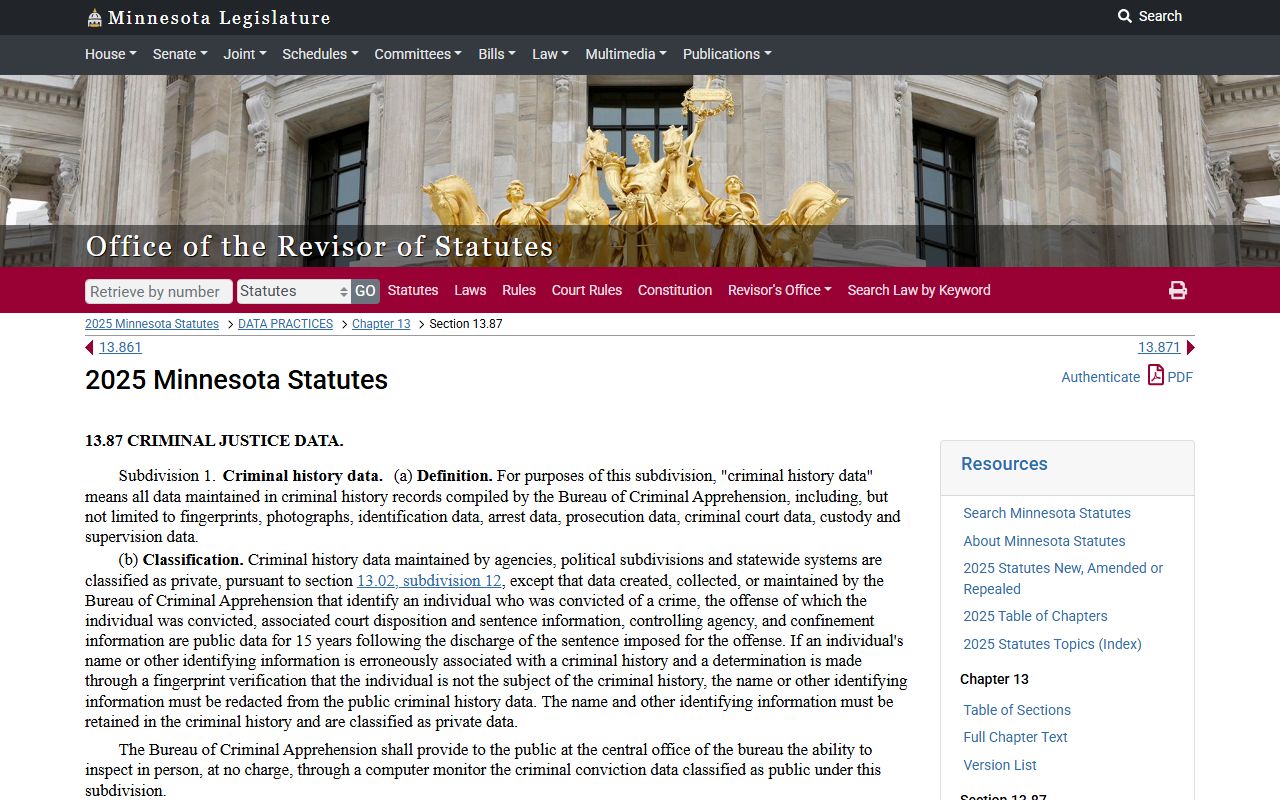
Section 13.87 governs the criminal history data side of the Ramsey County District Court records ecosystem.
Ramsey County Open Data Endpoints
The Sheriff's open data feeds plug into the District Court file flow. A booking number, a court file number, and a court date can be traced from the open data API back to the District Court file in MCRO. The Socrata sample endpoint demonstrates the JSON output that a developer or researcher might consume.
The Socrata sample is at opendata.ramseycountymn.gov.
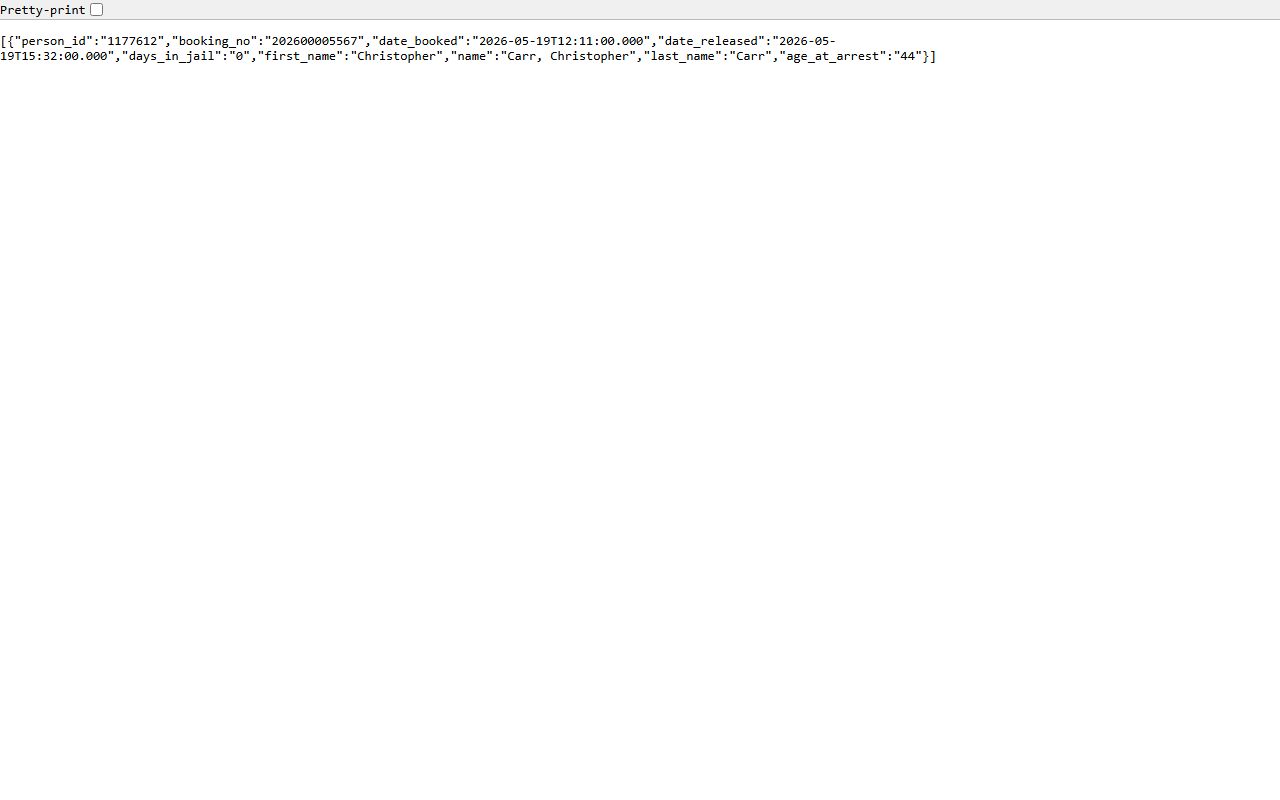
The sample endpoint shows the JSON output that feeds the Ramsey County District Court roster view.
Specialty and Problem-Solving Courts
Ramsey County District Court runs several specialty calendars that address the root drivers of repeat criminal cases. Drug Court takes eligible defendants with substance-use needs and offers treatment, supervision, and graduated incentives. DWI Court handles repeat or high-risk impaired-driving defendants on a treatment calendar. Mental Health Treatment Court works with defendants whose justice involvement ties to mental health needs. Veterans Treatment Court, credited to County Attorney John J. Choi in his official biography, supports veterans through a combination of court supervision, treatment, and veteran-specific services.
These programs are not separate courts in the Minnesota hierarchy; they are calendars and programs within the District Court. Eligibility, length, and graduation rules vary by program. The Ramsey court A-Z page lists current program contacts.
Security and Courthouse Access
The Second Judicial District courthouse complexes screen visitors for weapons and dangerous items. The locations and hours page warns that guns, knives including pen knives and key-chain knives, scissors including nail scissors, tasers, screwdrivers, hammers, box cutters, aerosol spray, mace, pepper spray, fingernail files and clippers, knitting and crochet needles, hair pins, glass containers, metal utensils, and cameras are not allowed inside. Visitors may face metal detector screening, hand-wand searches, and bag inspection. Security officers can confiscate other items at their discretion.
Cameras and recording equipment for evidence or court coverage must be arranged through the court technology team. ADA accommodation and language services in Spanish, Hmong, Somali, and other languages are available through the Judicial Branch links.